
- Buy Crypto
- Markets
- Futures
- Spot
- Copy Trade
 Earn
Earn- More
Why do Bitcoin and Ethereum Altcoins Fall When Bitcoin Rises?

Original Article Title: Why BTC and ETH Haven't Rallied with Other Risk Assets
Original Author: @GarrettBullish
Translation: Peggy, BlockBeats
Editor's Note: Against the backdrop of a rise in multiple asset classes, the phase lag of BTC and ETH is often simplistically attributed to their "risk asset" nature. This article argues that the core issue lies not in the macro environment, but in the deleveraging phase and market structure of the crypto market itself.
As deleveraging nears its end, trading activity declines, and stagnant funds struggle to counter the short-term volatility amplified by high-leverage retail traders, passive funds, and speculative trading. Before new inflows and FOMO sentiment return, the market is more sensitive to negative narratives, a structural outcome.
Historical analogies suggest that this performance is more likely a phase adjustment in a long-term cycle rather than a fundamental failure. This article attempts to move beyond short-term fluctuations, starting from cycles and structures to redefine the current position of BTC and ETH.
The following is the original article:
Bitcoin (BTC) and Ethereum (ETH) have recently significantly underperformed other risk assets.
We believe that the main reasons for this phenomenon include: the phase of the trading cycle, market microstructure, and the manipulation behavior of some exchanges, market makers, or speculative funds.
Market Background
First, the deleveraging-driven decline since October last year has dealt a heavy blow to high-leverage participants, especially retail traders. A large amount of speculative funds has been liquidated, making the overall market fragile and more risk-averse.
At the same time, AI-related stocks in China, Japan, Korea, and the United States have seen extremely aggressive rallies; the precious metals market has also experienced a surge driven by FOMO sentiment, resembling a "meme rally." The rise of these assets has absorbed a large amount of retail funds—which is crucial, as retail investors in Asia and the United States remain the predominant trading force in the crypto market.
Another structural issue is that: crypto assets have not yet fully integrated into the traditional financial system. In the traditional financial system, commodities, stocks, and forex can be traded in the same account with almost no friction in asset allocation switching; however, in reality, transferring funds from TradFi to the crypto market still faces multiple barriers in regulation, operational processes, and psychological aspects.
Furthermore, the proportion of institutional investors in the crypto market remains limited. Most participants are not professional investors, lack an independent analysis framework, and are easily influenced by speculative funds or exchanges acting as market makers, thus being swayed by emotion and narrative. Narratives such as the "four-year cycle" and "Christmas Curse" are repeatedly emphasized, despite lacking rigorous logic and solid data support.
A prevalent overly linear mindset exists in the market, such as directly attributing BTC's price volatility to a single event like the Japanese Yen appreciation in July 2024, without deeper analysis. These narratives are often rapidly disseminated and directly impact prices.
Next, we will break free from short-term narratives and analyze this issue from an independent thinking perspective.
The Importance of Time Dimension
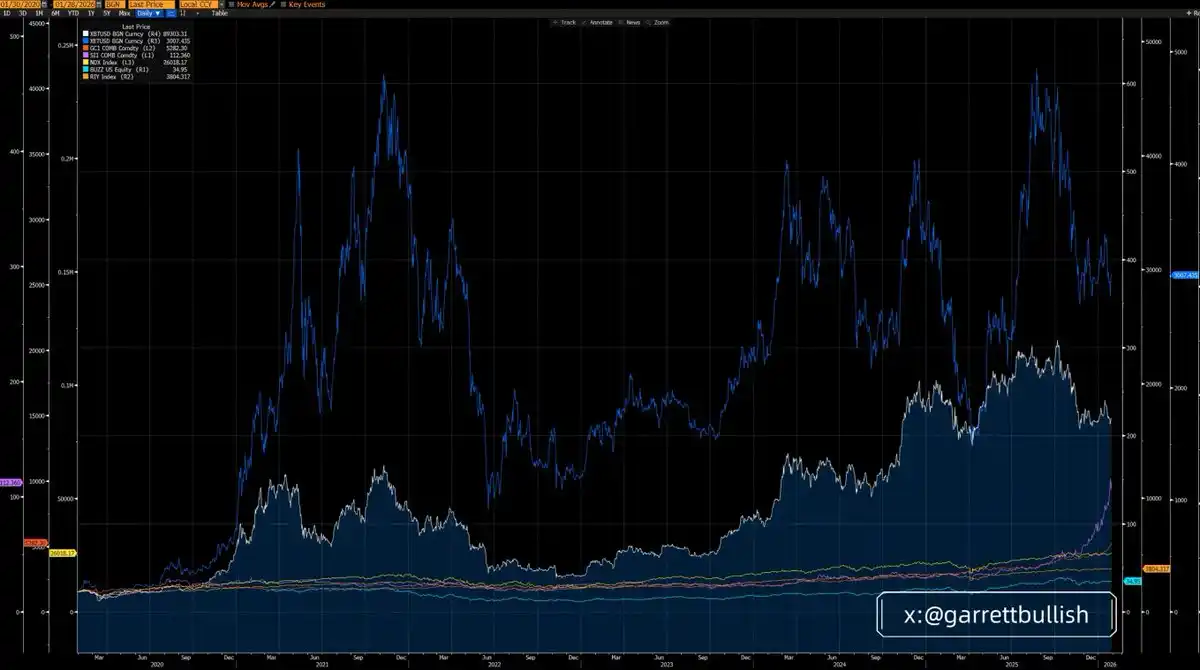
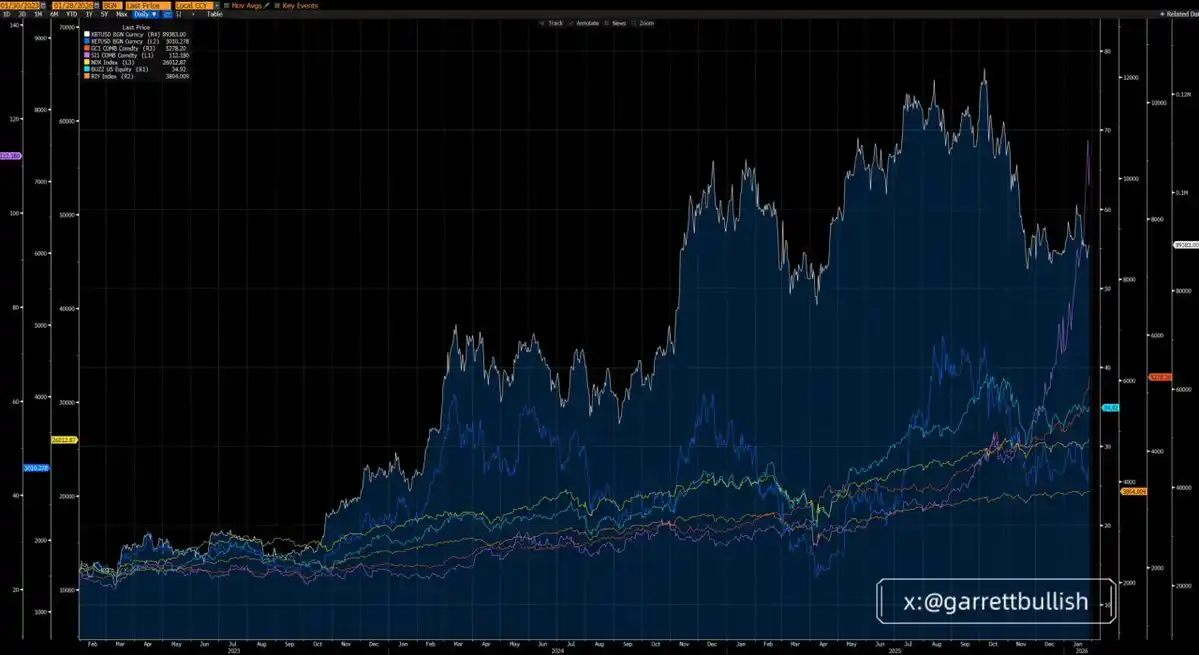
Viewed over a three-year period, BTC and ETH have indeed underperformed most major assets, with ETH showing the weakest performance.
However, when extended to a six-year period (since March 12, 2020), the performance of BTC and ETH is significantly better than most assets, with ETH emerging as the strongest performer.
Viewing from a longer time frame and in the macro context, the current so-called "short-term underperformance" is essentially a mean reversion process within a longer historical cycle.
Ignoring underlying logic and focusing only on short-term price fluctuations is one of the most common and deadly mistakes in investment analysis.
Rotation is a Normal Phenomenon
Before the short-squeeze rally in silver last October, silver was also one of the worst-performing types of risk assets; yet now, on a three-year time frame, silver has become one of the strongest-performing assets.
This change is highly similar to the current situation of BTC and ETH. Despite their short-term underperformance, they are still among the most advantaged asset classes on a six-year timeframe.
As long as the narrative of BTC as "digital gold" and a store of value tool remains fundamentally unchallenged, as long as ETH continues to integrate with the AI wave and serve as a core infrastructure in the Real World Asset (RWA) trend, there is no rational basis to believe they will continue to underperform other assets in the long run.
Once again emphasizing: ignoring fundamentals and solely relying on short-term price trends to draw conclusions is a severe analytical error.
Market Structure and Deleveraging
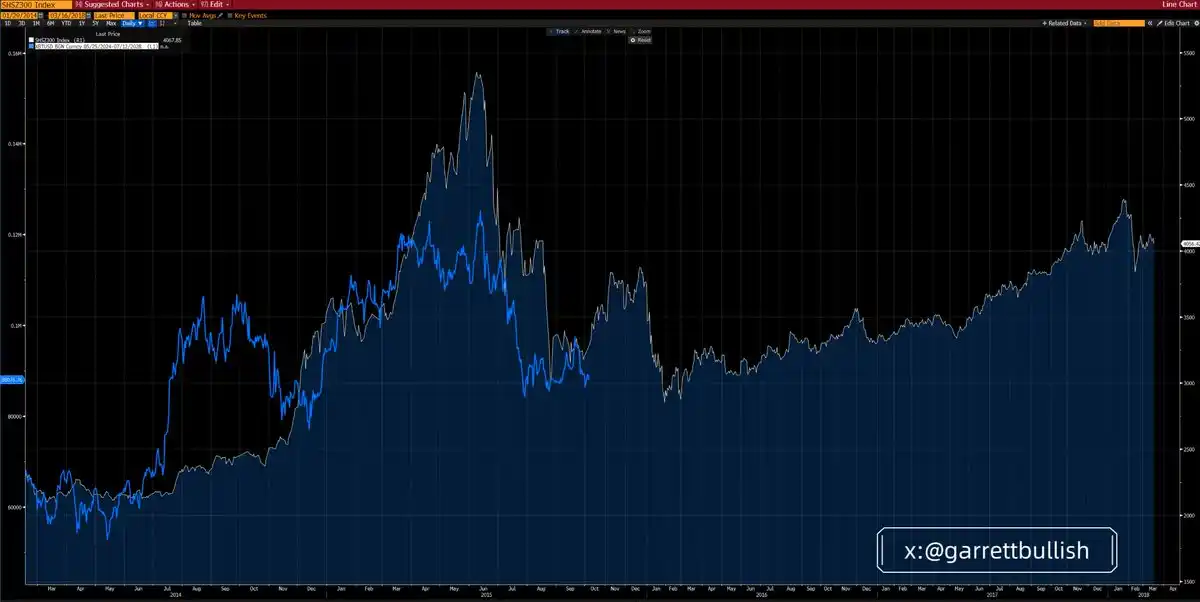
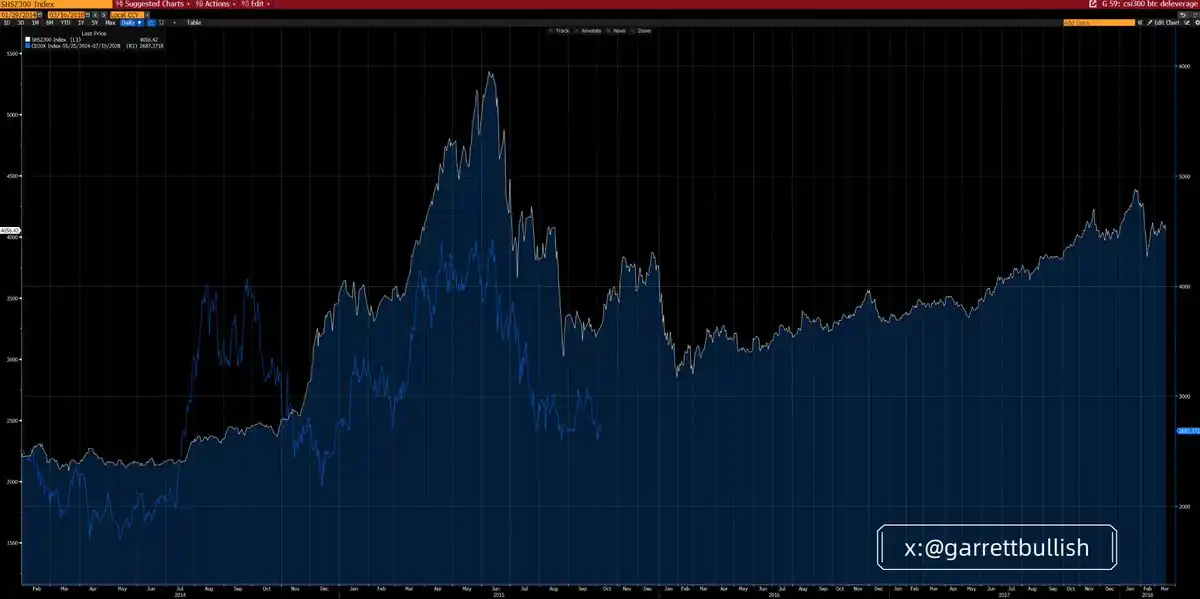
The current crypto market exhibits striking similarities to the environment in the 2015 Chinese A-share market as it transitioned from a high-leverage phase to a deleveraging phase.
In June 2015, following a leverage-driven bull market stagnation and a bursting valuation bubble, the A-share market entered a three-wave A-B-C downward structure in line with Elliott Wave Theory. After the C wave bottomed out, the market went through months of consolidation before gradually transitioning into a sustained multi-year bull market.
The core drivers of that prolonged bull market were low valuations of blue-chip assets, improving macroeconomic policy environment, and significantly loose monetary conditions.
Bitcoin (BTC) and the CD20 Index have almost perfectly replicated this "leverage to deleverage" evolutionary path in this cycle, showing a high degree of consistency in both timing and structural form.
The underlying similarity is quite clear: both market environments share characteristics such as high leverage, extreme volatility, a top driven by valuation bubbles and herd behavior, repeated deleveraging shocks, a prolonged and gradual decline, sustained decrease in volatility, and a futures market long-term contango structure.
In the current market, this contango structure is reflected in the discount of publicly traded company stock prices related to Digital Asset Treasury (DAT) compared to their mNAV (adjusted net asset value).
Meanwhile, the macro environment is gradually improving. Regulatory clarity is increasing, with legislation such as the Clarity Act driving continued progress. The U.S. Securities and Exchange Commission (SEC) and the Commodity Futures Trading Commission (CFTC) are actively promoting the development of on-chain US equities trading.
Monetary conditions are also becoming more accommodative: expectations of rate cuts are increasing, quantitative tightening (QT) is nearing its end, liquidity continues to flow into the repo market, and market expectations for the next Federal Reserve chair are increasingly dovish, collectively improving the overall liquidity environment.
ETH and Tesla: A Valuable Analogy
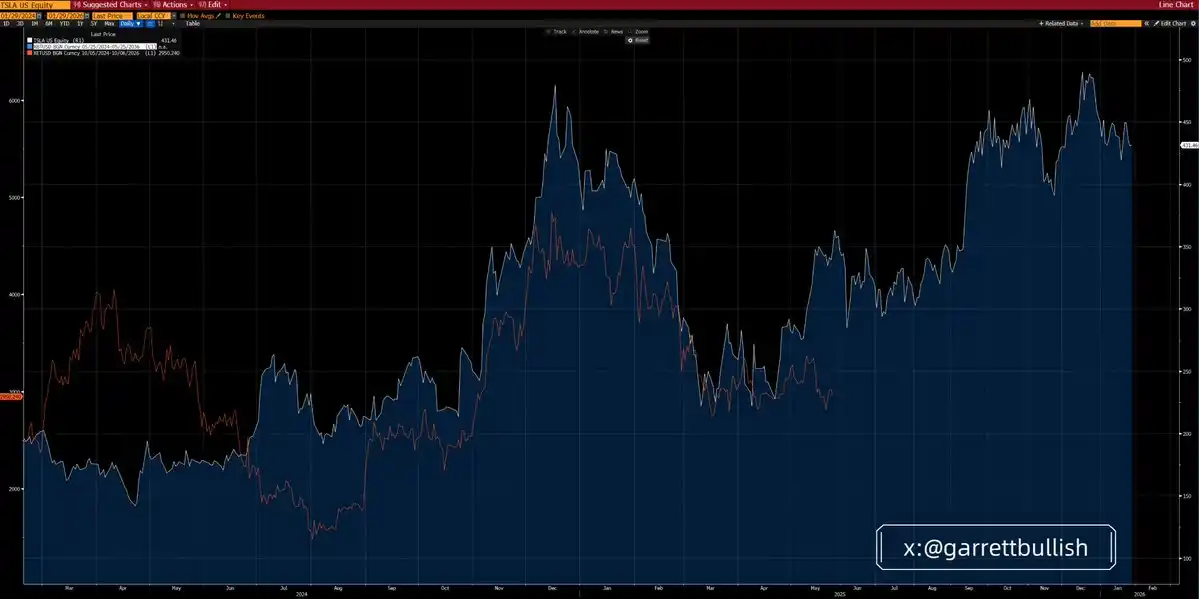
The recent price trend of ETH closely resembles the price performance of Tesla in 2024.
At that time, Tesla's stock price first formed a head and shoulders bottom structure, then experienced a rebound, traded sideways, surged again, entered a prolonged topping phase, swiftly declined, and underwent a long period of sideways consolidation at a low level.
It wasn't until May 2025 that Tesla finally broke out to the upside, officially starting a new bull market. Its upward momentum mainly came from the growth in the Chinese market sales, increased probability of Trump's reelection, and the monetization of its political network.
From the current perspective, ETH shows a high degree of similarity with Tesla at that time, both in technical form and fundamental background.
The underlying logic also has comparability: both have carried a technological narrative and meme attributes simultaneously, both have attracted a large amount of high-leverage funds, experienced intense volatility, peaked in a valuation bubble driven by group behavior, and then entered a period of repeated deleveraging adjustment.
Over time, market volatility gradually subsided, while fundamentals and the macro environment continued to improve.
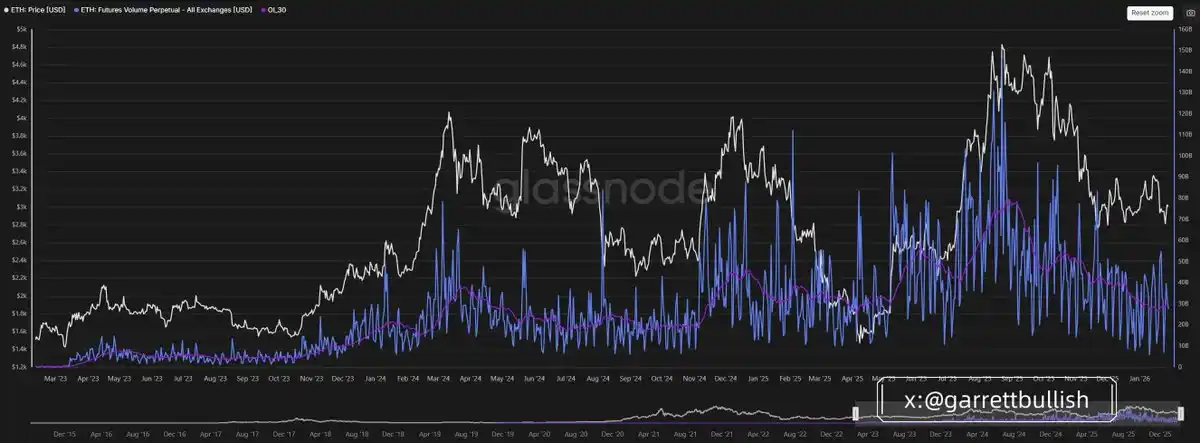
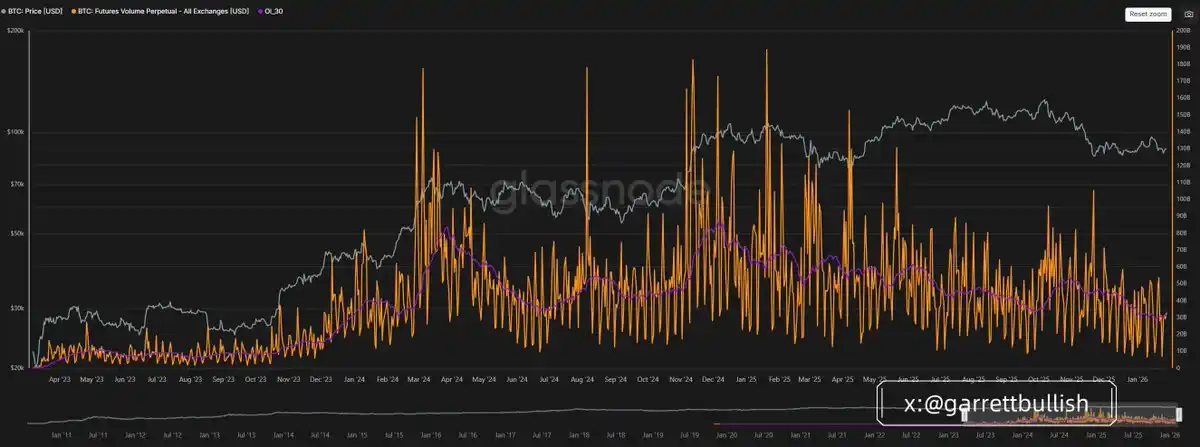
Looking at the futures trading volume, the market activity of BTC and ETH has reached historical lows, indicating that the deleveraging process is nearing its end.
Are BTC and ETH "Risk Assets"?
Recently, a rather strange narrative has emerged in the market: defining BTC and ETH simply as "risk assets" and using this to explain why they have not followed the uptrend of US stocks, A-shares, precious metals, or base metals.
By definition, risk assets usually have high volatility and high beta characteristics. Whether from the perspective of behavioral finance or quantitative statistics, the US stock market, A-shares, base metals, BTC, and ETH all meet this standard and often benefit in a "risk-on" environment.
However, BTC and ETH have additional properties. Due to the presence of the DeFi ecosystem and on-chain settlement mechanism, they also exhibit a hedge-like feature similar to precious metals in certain contexts, especially when geopolitical pressures rise.
To simply label BTC and ETH as "pure risk assets" and assert that they cannot benefit from macro expansion is essentially a narrative that selectively emphasizes negative factors.
Commonly cited examples include:
EU-US Potential Tariff Conflict Due to Greenland Issue
Canada-US Tariff Dispute
And the Potential US-Iran Military Conflict
This line of argumentation is essentially a form of cherry-picking and double standards.
In theory, if these risks were truly systemic, then all risk assets should have dropped concurrently, apart from base metals that may benefit from war demands. Yet the reality is that these risks do not have the foundations to escalate into significant systemic shocks.
The demand for AI and high-tech remains robust and to a large extent immune to geopolitical noise, especially in core economies like China and the US. Therefore, the stock market has not substantively priced in these risks.
More importantly, most of these concerns have been downgraded or debunked by facts. This raises a key question: why are BTC and ETH exceptionally sensitive to negative narratives but exhibit a slow response to positive developments or the fading of negative factors?
The Real Reason
We believe the main reason comes from structural issues within the crypto market itself. The current market is at the tail end of a deleveraging cycle, with overall sentiment being risk-averse.
The crypto market is still dominated by retail participants, with limited involvement from professional institutions. ETF flows mostly reflect passive sentiment-driven moves rather than active allocations based on fundamentals and judgment.
Likewise, the positioning of most Digital Asset Treasuries (DAT) tends to be passive—whether through direct operations or third-party passive fund managers, they usually employ non-aggressive algorithmic trading strategies like VWAP, TWAP, with the core goal of reducing intraday volatility.
This stands in stark contrast to speculative funds. Their primary goal is to create intraday volatility—and in the current stage, this volatility mostly manifests in the downward direction to manipulate price action.
Meanwhile, retail traders commonly use 10-20x leverage. This makes exchanges, market makers, or speculative funds more inclined to profit from market microstructure rather than endure medium- to long-term price fluctuations.
We often observe concentrated sell-offs during illiquid periods, especially when Asian or US investors are asleep, such as during the Asian early morning hours from 00:00 to 08:00. These fluctuations often trigger chain reactions, including liquidations, margin calls, and passive selling, further amplifying the downward momentum.
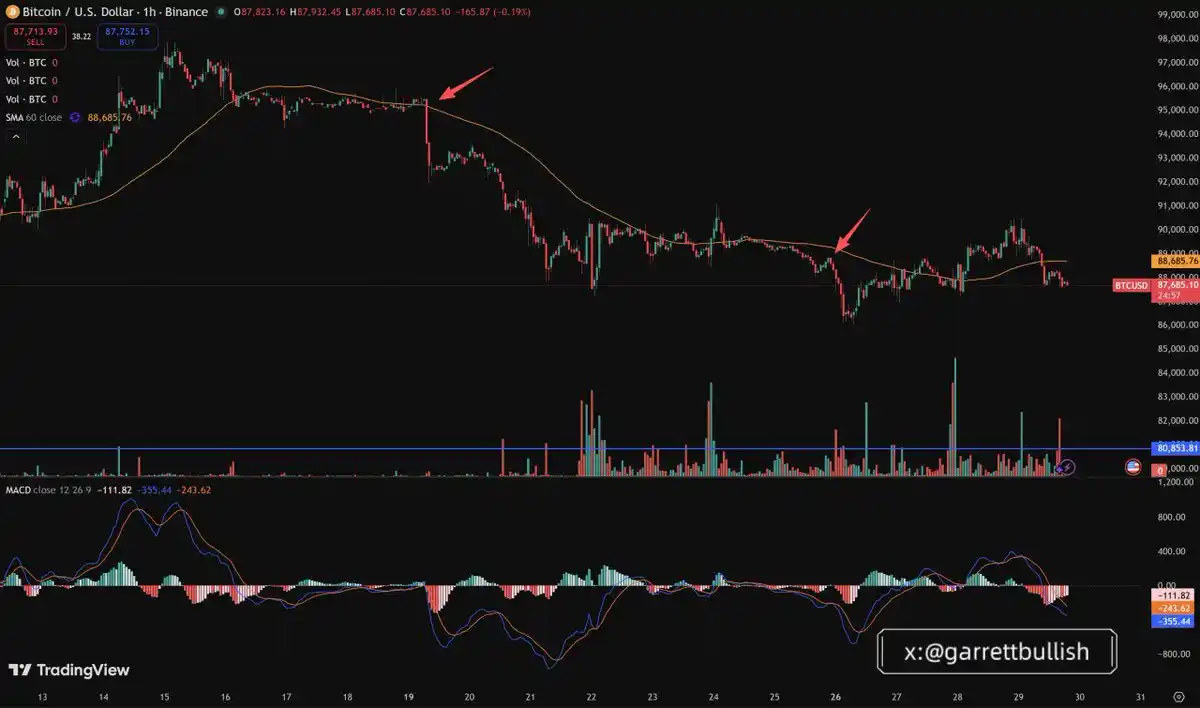
Merely relying on existing funds without substantial new inflows or the return of FOMO sentiment is insufficient to counteract the aforementioned market behavior.
Definition of Risk Assets
Risk assets refer to financial instruments with a certain level of risk characteristics, including stocks, commodities, high-yield bonds, real estate, and currencies.
In a broad sense, risk assets are any financial securities or investment instruments that are not considered "risk-free." The common feature of these assets is that their prices are volatile, and their value may change significantly over time.
Common types of risk assets include:
Stocks (Equities / Stocks):
Shares of publicly traded companies whose prices are influenced by various factors such as market conditions and company performance, leading to potentially significant price fluctuations.
Commodities:
Physical assets such as crude oil, gold, agricultural products, whose prices are mainly affected by supply and demand dynamics.
High-Yield Bonds:
Bonds offering higher interest rates due to lower credit ratings, but also accompanied by increased default risk.
Real Estate:
Investment in immovable property, the value of which fluctuates with market cycles, economic conditions, and policy changes.
Currencies:
Various currencies in the foreign exchange market, whose prices may rapidly fluctuate due to geopolitical events, macroeconomic data, and policy changes.
Key characteristics of risk assets
Volatility:
Prices of risk assets frequently fluctuate, potentially resulting in both gains and losses.
Return and Risk Coexist:
Generally, the higher the asset's risk, the higher the potential return, but at the same time, the probability of loss is also greater.
High Sensitivity to Market Environment:
The value of risk assets is influenced by various factors, including interest rate changes, macroeconomic conditions, and investor sentiment.
You may also like

Average Earnings per Person $90 Million, Earth's Biggest Private Buyer of Gold

Wall Street Giant 'Forces' SEC Showdown, Crypto Exemption Setback in January

Glassnode: Undercurrent Surges at $83k Resistance, BTC Enters Oscillating Accumulation "Deep Dive Zone"

Coinbase vs. Wall Street: Who Is Deciding the Next Move for the US Financial System?

These people and projects are the focus of ERC-8004

Geopolitical Risk Escalation: US Stocks, Precious Metals Simultaneously 'Turn Tail,' Bitcoin Struggles to Hold $81,000

Key Market Information Discrepancy on January 30th - A Must-Read! | Alpha Morning Report

The DAO Reboot, Backpack Prepares for TGE, What's the Overseas Crypto Community Talking About Today?

「Prediction Market Leader Stock」 Kalshi Surges Over 20% in Pre-market Trading, Is it Still a Buy?
Why do Bitcoin and Ethereum Altcoins Fall When Bitcoin Rises?
Risk Asset Rollercoaster, the World Is on Edge Over the US vs. Iran

HYPE Price Target Achieves $50 as Hyperliquid Reduces Team Token Unlock by 90% — Assessing The Rally’s Longevity
Key Takeaways Hyperliquid significantly cut its monthly token unlocks by 90%, sparking renewed interest in its HYPE token’s…

Hong Kong-Based OSL Group Launches $200M Equity Raise for Stablecoin and Payments Expansion
Key Takeaways OSL Group, a prominent digital asset platform in Asia, has initiated a significant $200 million equity…

Gold Price Prediction: Current Trends and Future Outlook for January 28, 2026
Key Takeaways Gold and silver prices play a significant role in the global economy, reflecting both market trends…

GameStop 2.0? Why Robinhood’s CEO Advocates Tokenization for Trading Halts
Key Takeaways Tokenized stocks are seen as a solution to counteract the disruptions seen in traditional equity markets…

Central Bank of the UAE Endorses First USD-Backed Stablecoin
Key Takeaways The UAE Central Bank has endorsed the first US dollar-backed stablecoin, USDU, to streamline compliant settlements…

Can the Gold Price Rise to $6,000?
Key Takeaways Gold prices in 2026 have experienced dramatic surges, reaching unprecedented levels in just the first month…

Solana Loses Major Portion of Validators as Smaller Nodes Exit: Concerns Over Centralization
Key Takeaways: Solana has experienced a significant drop in active validators from a high of 2,560 in March…


 App
App